
The strongest contributors to performance were Kyocera, Azbil, Heijmans and BAM Group. This quarters reporting season proved to be another positive one, with many of our companies announcing profit upgrades, higher dividends and buybacks and strong earnings.
We were happy to see profit upgrades from ABB, Pepco, Next plc, Fineco, Hikari Tsushin and Open House Group and zero downgrades from our companies. Of course we will occasionally have negative surprises in our portfolio, this is a reality in investing. Luckily this reporting season we had none.
As we have previously discussed, many companies in our portfolio are “pregnant” with significant capital allocation improvements, we saw this from Azbil which released a large buyback announcement and strong earnings, with the share price rising ~10%+ on the day. These are the exact sort of improvements we look for and are happy to see these regularly occurring.
The weakest developments during the month were TMX Group, Open House, Kandenko and Hikari Tsushin. TMX was quite a specific case where all North American stock exchanges sold off on the perceived risk of crypto token futures taking over from institutional futures, we see this as noise as the business continues to grow incredibly well.
For our Japanese names, Open House and Kandenko (which had both been extremely strong performers for us) have a “Hormuz overhang” from the war in Iran. Almost all companies which are classified as “Construction” in Japan have sold off as a group over concerns regarding inflation and shortage of Naptha (plastic derivative). We met both management teams in Tokyo during the month and discussed these possible challenges, both companies have significant levers to overcome any challenges (they’re currently unaffected).
Key market events and trends
A 5% gain in MSCI World (EUR) during May put the old adage "sell in May and go away" firmly to rest. This may be a sign of the times. The performance pockets of 2026 tell a story of a market in constant motion: the year opened with a powerful rally in gold and silver alongside a sharp rotation out of software, followed by an oil and gas surge as the Iran conflict dominated headlines in March. When hostilities cooled, AI infrastructure — and memory and CPU semiconductors in particular — took centre stage from April onwards. Even seasoned investors have rarely witnessed so many meaningful sector rotations in such a short period of time.
One is tempted to ask whether AI-driven investment algorithms are amplifying short-term price moves. To put this in perspective: long-term investment returns are ultimately the sum of short-term returns. At Brock Milton Capital, we take a longer-term view of businesses, sectors, and regions when constructing preferred exposures — which makes the strong May performance of our funds all the more encouraging. Could simply understanding how algorithmic strategies interact with pricing give the fundamental investor an edge over the machines?
The fundamental backdrop continues to strengthen. Entering 2026, consensus expected earnings growth of approximately 14% for the year; that estimate has since been revised up to 20%, followed by 14% growth in 2027. And despite equity markets trading near all-time highs, the valuation on 2027 earnings remains undemanding at 16.5x.
Finally, Europe is changing at a pace that may not yet be fully reflected in regional market valuations. SoftBank's announced €75 billion AI data centre investment in France is one recent example. More broadly, the emerging alignment among the "Democratic Seven" — the EU, Australia, New Zealand, Japan, South Korea, Canada, and the UK — may represent a structural shift that equity markets have been slow to price.
Portfolio changes during the month
During the month we visited Tokyo and Kyoto meeting with 35 companies management teams across the course of 3 weeks. We met with both our holdings and prospective holdings.
During the month be bought four compnaies and sold two. The new companies are:
SWCC
SWCC is a classic case of “Japan reform” where it has a (very good) optical cable business which is benefitting significantly from Data Center build out and the AI trend. It also has some poor margin business in the auto and industrial business. New Management have come in, with an ROIC focus, and are exiting their poor quality business and investing heavily in their high quality business.
Samsung
Samsung as a diversified conglomerate has primarily benefited from the huge memory upcycle we are seeing globally which has allowed it to generate enormous profits. Positively, Samsung is now signing LTA (Long Term Agreements) at the current prices to lock in this impressive profitability.
Mersen
Mersen is a French listed, but Global Electronics and Graphite business. Mersen had previously had some issues regarding poor utilisation at some of their factories and had been through an enormous CAPEX cycle which reduced Free Cash flow. However, Mersen is benefitting significantly from a large electronics upcycle and very strong demand for their products which has helped fix their factory utilisation issues, in addition their investment phase is coming to an end.
Baycurrent
Baycurrent is a very high quality Japanese consultant focused on Banking, Cyber Security and AI. With an incredibly impressive history of 25%+ organic growth and 35% EBITDA margins, there’s a lot to like about their business model. Recently Baycurrent was, unfairly, punished on AI fears, even though AI appears to be a huge benefit to their business model. The company came out with a large buyback and is trading extremely well.
Fund positioning
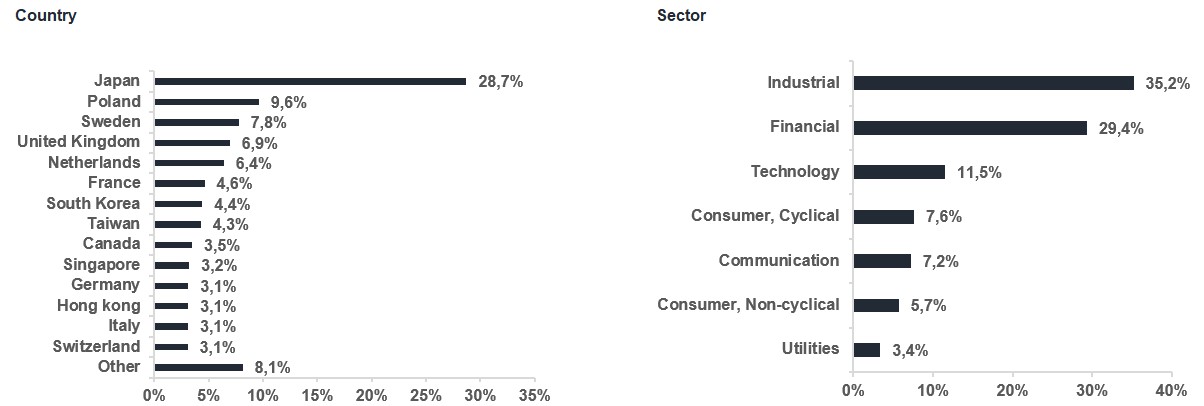
Overall we are very happy with the diversified investment themes taking place across the portfolio, whether it be Japanese reform, Asian Tech, Polish growth or European aggressive improvement, we are finding more ideas than we have space for currently. Post our trip to Japan we found a number of incredibly interesting possibilities that may make it into the portfolio.
*MSCI ACWI ex USA Net Total Return USD Index in EUR
* The performance-based fee is 10% of the part of the total return that exceeds a so-called return threshold defined as the MSCI ACWI ex USA Net Total Return USD Index In EUR, and is calculated according to the "high watermark" principle.

BAM Group

WARSAW STOCK EXCHANGE

KYOCERA

TSMC

Sdiptech
Riskinformation
Past performance is not a guarantee of future returns. The value of shares in the fund may go up or down, and an investor may not get back the amount originally invested
Monthly Newsletter | 11 aug 2026

Monthly Newsletter | 11 aug 2026

Monthly Newsletter | 11 aug 2026