
The strongest contributors to performance were Singapore Exchange, TMX Group, and Kyoto Financial. Japanese corporate reform measures continued to support returns, while stock exchanges benefited from elevated market volatility.
We continue to see aggressive reform activity from Japanese companies. During the month, Kyoto Financial announced a significant reduction in its holding in Nintendo, alongside sales of other, as yet unnamed, positions. The company is scheduled to release a new medium-term plan in April 2026, where we believe it will outline further substantial reductions in cross-shareholdings as well as additional buybacks. Kyoto Financial has been one of our best-performing holdings since inception, with the shares up 23% year to date and 89% over the last 12 months.
The weakest contributors during the month were Hermes and Takasago Thermal Engineering. Hermes was pressured by weaker sentiment related to the ongoing conflict in the Middle East.
At present, developments in the Middle East, along with concerns around the availability of oil and related products, are having an outsized influence on share price movements. We view this as short-term noise that is likely to resolve over the short to medium term. Encouragingly, the earnings and results across almost all of our portfolio companies have remained very strong, and we believe many are candidates for upgrades later in the year, which should be supportive for returns.
Key market events and trends
Q1 2026 has now come to an end and we can say that it has been especially eventful in many ways. For one, US foreign policy has swung from one incitement to the next. The kidnapping of Venezuela's president, threats to forcibly occupy Greenland, and, finally, the attack with Israel that eliminated Iran's leadership. The subsequent conflict has impacted the global energy market, with the oil price shooting up 75% to more than USD 100 per barrel and interest rates rising in tandem. Given this, consumer sentiment remains weak and households around the world are building up savings buffers, although private consumption has risen modestly.
The equity markets shook off much of the initial impact and rose 5–8% in a widespread rotation from mega-cap tech stocks to the broader market. The Iran conflict brought this to a halt, and share prices have since fallen by some 10% from the peak, leaving the larger indexes at around -1% for the year so far.
Profit expectations for 2026 thus remain good, with consensus pointing at 19% growth, up strongly from the 14% that was forecast at the start of the year. Tech is the key driver, with energy stocks having also seen considerable upward profit estimate revisions. A subsector that stands out is semiconductors, where a handful of memory producers—Micron, Samsung, and SK Hynix—have together seen their 2026 profit forecasts doubling thanks to higher prices for traditional memory chips. Semiconductor capacity will soon catch up and prices for memory chips will normalize. This year, and possibly also next, look set to be exceptionally profitable, spurred by increased use of AI and the expansion of datacenters for the companies referred to as hyperscalers.
Portfolio changes during the month
The fund made no changes during the month.
That said, we are actively working on a number of exciting new ideas that we expect to add in due course. Following a large conference in London, we are also progressing research on several attractive Japanese reform candidates.
We will be travelling to Japan in the second week of May, where we have requested 50 one-on-one meetings over a two-week period. We look forward to reporting back on our findings.
Fund positioning
Overall, the fund remains well positioned for a number of idiosyncratic themes that we believe will continue to drive strong shareholder returns.
Whether markets are focused on conflict in the Middle East, the impact of AI on software companies, or other macro concerns, we believe that Japanese shareholder reform, the Polish economic recovery, and self-improvement initiatives across European companies will continue to create attractive opportunities.
We prefer exposure to themes that are not heavily dependent on global politics, and we continue to avoid volatile “battleground” situations.
Thank you for entrusting us with your capital.
*MSCI ACWI ex USA Net Total Return USD Index in EUR
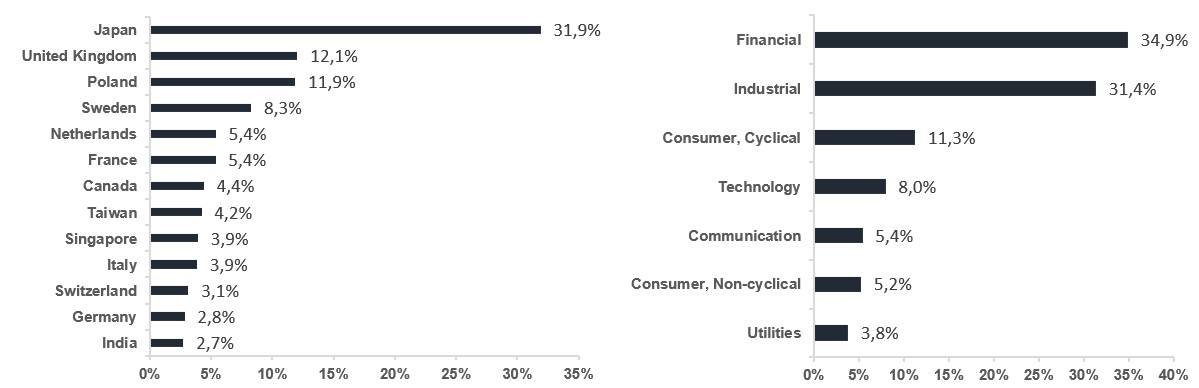
* The performance-based fee is 10% of the part of the total return that exceeds a so-called return threshold defined as the MSCI ACWI ex USA Net Total Return USD Index In EUR, and is calculated according to the "high watermark" principle.

Sdiptech
TMX Group

WARSAW STOCK EXCHANGE
TSMC
Azbil
Riskinformation
Past performance is not a guarantee of future returns. The value of shares in the fund may go up or down, and an investor may not get back the amount originally invested
Monthly Newsletter | 9 sep 2026

Monthly Newsletter | 9 sep 2026

Monthly Newsletter | 9 sep 2026