
The strongest contributors to performance during the month were Pepco Group, Warsaw Stock Exchange, Allegro, BayCurrent and Hikari Tsushin.
Pepco was the largest contributor after a strong third-quarter update. Like-for-like revenue at the Pepco brand grew 5.4% excluding FMCG, while management upgraded FY26 guidance to a gross margin of approximately 51%, mid-teens EBITDA growth and approximately €300 million of unlevered free cash flow. The company also launched a pro-rata tender buyback of up to €400 million, later increasing the fixed tender price to PLN 47.52 as the shares appreciated.
Allegro also performed strongly. Permira's sale of its remaining stake removed a long-standing share overhang, meaning there is no longer a persistent seller absorbing demand. This should allow Allegro's open-market buyback to have a more direct effect; the first phase authorises up to PLN 800 million of repurchases for cancellation.
The weakest contributors during the month were Taiwan Semiconductor, SK Hynix, Shiga Bank and BuySell Technologies.
Key market events and trends
At first glance, July appeared to be a calm month, with the global equity market (MSCI World in EUR) dropping back by 0.6%. But this hides one of the year's most powerful sector rotations. Semiconductors fell by 20%, the South Korean equity market lost 30%, and Tesla was markedly down, while the US telecom sector rose by 15%, energy climbed up 8%, the finance sector saw a 7% rise, and everyday pharma was up 5%.
This correction centered on AI-related topics. The greatest drop was seen in the AI and semiconductor spaces, plus the South Korean market, with its extensive exposure to memory chips. These have all been extremely popular, with increases of around 70% during the first half of the year. On top of this, we saw profit-taking, a more austere Fed under new chair Kevin Warsh, and a wave of liquidation of leveraged positions, including the Situational Awareness Fund being compelled to sell assets to meet the margin call. The underlying demand held firm, however, and reports from semiconductor companies and hyperscalers showed continued solid growth with rising revenue and profits. Overall, this appears to have been a healthy valuation correction of a structurally intact trend, rather than a sign of weakening fundamentals.
Estimates have been revised up—and our forecasts likewise. At the start of the year, we had forecast a total return of 10–15% for 2026. We raised this to around 15% after the convincing first quarter reports. And now—despite July's rotation—we see scope to lift it again, this time to 15–20%, given the second quarter results and updated valuations in play. This year's returns will be driven entirely by profit growth. The latest increases in long-term bond yields could pose a risk to keep an eye on, however, as if US 10-year yields surpass 5%, it could put pressure on share prices in general.
What do we anticipate for the fall? We expect the second half of the year to remain variable, the tone set by sector rotation rather than a broad-based general pickup. The underweight sectors—groceries, healthcare, telecom, and finance—seem to hold the best opportunities to continue making up lost ground, especially as many active investors are still underweight in these spaces. We would consider possible ongoing weakness in semiconductors as a buying opportunity, given the solid profit development expected there in 2026 and 2027.
Portfolio changes during the month
During July we initiated one new position: Yonex. We also exited FinecoBank, Hermès and TMX Group, reallocating capital toward more attractive opportunities within the existing portfolio.
Yonex is a global leader in badminton and tennis equipment. The company is growing rapidly and is investing in a new factory that is expected to increase production capacity by approximately 70%. This should help support further growth while preserving the manufacturing quality that underpins the brand.
Fund positioning
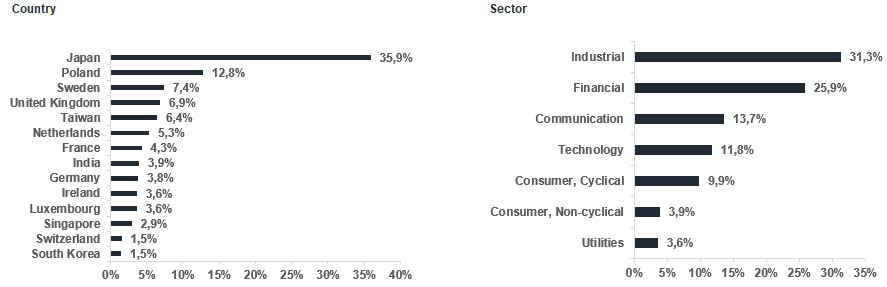
We remain very optimistic about the opportunities available across the portfolio. Our largest investment themes continue to be Japanese corporate reform, Asian technology, financial market infrastructure and European businesses undergoing meaningful capital allocation improvements. We continue to see an attractive pipeline of new investment opportunities and believe the portfolio remains well positioned for long-term compounding.
*MSCI ACWI ex USA NTR USD Index in EUR
* The performance-based fee is 10% of the part of the total return that exceeds a so-called return threshold defined as the MSCI ACWI ex USA Net Total Return USD Index In EUR, and is calculated according to the "high watermark" principle.

WARSAW STOCK EXCHANGE

Allegro
Pepco

Mersen

BAM Group
Riskinformation
Past performance is not a guarantee of future returns. The value of shares in the fund may go up or down, and an investor may not get back the amount originally invested
Monthly Newsletter | 11 aug 2026

Monthly Newsletter | 11 aug 2026

Monthly Newsletter | 11 aug 2026