
The strongest contributors to the fund's returns in September were AMD, Mediatek, and Intel, while the weakest were flatexDEGIRO, Autodesk, and Munters.
September began cautiously but ended with strong gains. At the start of the month, two of the world's largest semiconductor companies reported, giving their views on the future. Nvidia raised its guidance for next year from 45% to 70% growth. We have seen solid increases like this in guidance before, but that the company already did so in Q2 for next year's growth is a rare occurrence. Sector colleague Broadcom was not to be outdone when releasing its results in the first week of September, guiding for a doubling in its AI revenues, not just for 2027 but also for 2028. Demand in this case comes from Google and Anthropic, which hiked their initiatives for their own AI chips, developed in conjunction with Broadcom.
During the month, we also saw Anthropic highlighting and warning about rapid developments in AI, contributing to the more cautious trend at the start of the month. This led Trump to turn sour, as he believes that AI (or "super intelligence" as he has renamed it) is both existential and central to the US's ability to remain the world leader in tech. An agreement has since been reached that the development will continue, but that powerful new AI models will be rigorously tested internally before being launched.
The US 10-year yield passed 5% in September as the persistently high energy prices are keeping inflation 2% over the target. Despite this, share prices for US tech firms (and tech companies in general) continued to increase robustly during the month. AMD and Intel, for example, saw rises of around 30%, while the semiconductor index SOX was up by just over 12% in a month.
The next big step in the tech sector will be Antrhropic's IPO, which appears likely to happen as soon as mid-November. We believe the company will be listed at a valuation of around USD 2–3bn and thus qualify as one of the world's ten largest companies. According to reports, Anthropic today has annual revenues of USD 65bn but is likely to end the year at around USD 100bn (for reference, Google draws in about USD 500bn a year). This figure sat at around USD 9bn at the start of the year.
During September, we undertook an exciting analyst trip to Silicon Valley, meeting more than 20 companies across the tech and semiconductor value chain. You can read about it here.
Key market events and trends
Year-to-date, the MSCI World index is up 17% in EUR. Returns have been driven by particularly robust profit growth, for which consensus estimates now point to more than 25% for 2026, while profit growth estimates for 2027 have been raised to 17% (from 14%). Excluding the rising interest rates, particularly in the US, share prices would have risen by more than 20% so far.
Bond yields around the world are up, and real interest rates in the US touched levels not seen since the early 2000s. Part of this rise can be explained by energy-driven inflation, but credit demand has also increased as governments continue to run unsustainable deficits, while capex investments in AI data centers push credit demand up further. As credit demand has now surpassed what the system can meet, real interest rates rise. Simply put, there is more demand for capital than supply, propelling the cost of capital upwards.
With share prices up 17% during 2026 and profits likely to surpass 25%, there is an implicit valuation contraction justified by the higher interest rates. Firstly, investors will be tempted to sell shares to generate a predictable income stream from bonds in the coming ten, 20, or 30 years. Secondly, the present value of shares will decrease as the discount rate rises.
Currently, the earnings growth rate appears able to offset the impact of higher interest rates. But as interest rates increase further, such as to 6.0% for the US 10-year yield, the equity markets will encounter problems. On the other hand, shares should perform well if inflation weakens during 2027, as is widely expected, with less headwind from the higher interest rates.
Q3 2026 reporting season is around the corner, and profits for S&P 500 companies are expected to be up 30%, spurred by remarkable growth of 65% by the tech sector. In Europe, the Stoxx 600 is heading for profit growth of 17%, thanks to the energy sector.
Portfolio changes
We bought two new holdings during September: Celestica and Meta.
Celestica is a Canadian EMS company that manufactures Google and OpenAI's own AI chips, as well as network equipment for data centers. We believe the trend towards more internally developed AI chips (ASICs) is only just beginning, and we will see a sizable increase in the coming years. The company is expected to grow by 65% this year and by more than 70% next year. The company recently took in capital to finance this extensive growth, a move the market initially viewed negatively. We used this opportunity to buy in at a particularly attractive P/E valuation of 11x. Since then, the share price has risen by just over 35%.
Meta returns to our portfolio after an absence. In September, it launched its own AI agent, Muse, which quickly topped the list of the most downloaded apps. At the time of writing, it has been downloaded by more than five million users in just three weeks, which is a speedier start than for the leading AI apps like ChatGPT, Claude, and Grok. Muse is intended to operate as a personal assistant integrated with a range of third-party apps and Meta's own services, such as WhatsApp and Instagram. Still, the most interesting in the long run is that a product like Muse provides Meta with a route into the large corporate market. The company's total addressable market (TAM) thus grows substantially, opening up new opportunities to earn money on AI initiatives.
Its share price currently trades around a historical average of 20x profit. We see potential for a higher valuation if a larger share of earnings start to flow from corporate customers and not just consumers, similar to Alphabet, Microsoft, and Amazon.
The fund's positioning
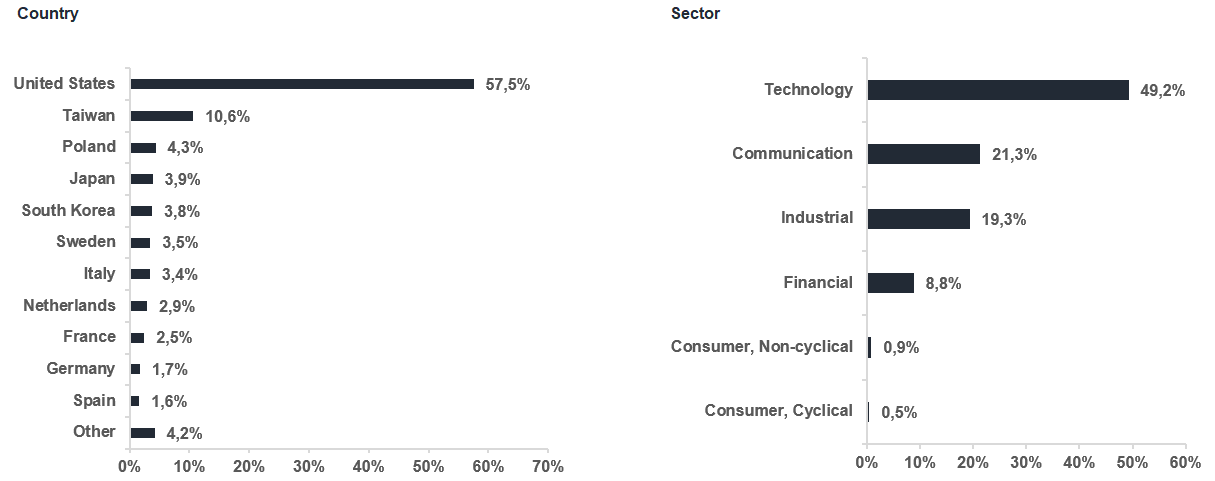
The fund currently comprises 45 companies exposed to a range of sectors, geographies and drivers, with companies chosen on their own merits. We do not limit ourselves to IT companies but also invest in those across various sectors benefiting from technology. We believe a concentrated but also diversified, actively managed global technology fund focused on stockpicking has all the prerequisites to deliver great returns to its unitholders over time.
*MSCI AC World NTR $ in EUR
* The performance-based fee is 10% of the part of the total return that exceeds a so-called return threshold defined as the MSCI All Country World Daily Index (NTR), and is calculated according to the "high watermark" principle.
Riskinformation
Past performance is not a guarantee of future returns. The value of shares in the fund may go up or down, and an investor may not get back the amount originally invested
Monthly Newsletter | 9 okt 2026

Monthly Newsletter | 8 okt 2026

Monthly Newsletter | 7 okt 2026