
The strongest contributors to the fund's returns during the month were Climb Global, BAM Group, and Mersen, while the weakest were flatexDEGIRO, First Advantage, and Porr Group.
The share price increases for the three best contributors were sentiment-driven thanks to specific company news. Climb Global performed well, like many other cybersecurity firms, as the market priced in that investments in protection from AI-directed cyberattacks will increase markedly in the future; BAM Group saw its share price up after an analysis firm raised its earnings expectations for the company by more than 20% for the next three years; and the valuation of Mersen was bolstered by an order from GE Vernova. Although the order was not of great importance, it offered further evidence of how well Mersen's products are positioned for increasingly complex electric power systems.
Among the weakest contributors, it was primarily flatexDEGIRO that stood out, losing almost one-quarter of its stock market value in a month owing to turbulence on its board and changes in management. The company stated that the departing board members wanted to deviate from the previously announced strategy and when this was denied, they chose to leave their board positions ahead of time. The management changes stemmed from the company wanting to increase its focus on commercial development, which has been disappointing this year, with customer acquisition far below the target despite increased marketing activity. This suggests that the company has delivered a solid operating performance throughout the year, with increased trading activity, robust net interest income, and good cost control.
Key market events and trends
Year-to-date, the MSCI World index is up 17% in EUR. Returns have been driven by particularly robust profit growth, for which consensus estimates now point to more than 25% for 2026, while profit growth estimates for 2027 have been raised to 17% (from 14%). Excluding the rising interest rates, particularly in the US, share prices would have risen by more than 20% so far.
Bond yields around the world are up, and real interest rates in the US touched levels not seen since the early 2000s. Part of this rise can be explained by energy-driven inflation, but credit demand has also increased as governments continue to run unsustainable deficits, while capex investments in AI data centers push credit demand up further. As credit demand has now surpassed what the system can meet, real interest rates rise. Simply put, there is more demand for capital than supply, propelling the cost of capital upwards.
With share prices up 17% during 2026 and profits likely to surpass 25%, there is an implicit valuation contraction justified by the higher interest rates. Firstly, investors will be tempted to sell shares to generate a predictable income stream from bonds in the coming ten, 20, or 30 years. Secondly, the present value of shares will decrease as the discount rate rises.
Currently, the earnings growth rate appears able to offset the impact of higher interest rates. But as interest rates increase further, such as to 6.0% for the US 10-year yield, the equity markets will encounter problems. On the other hand, shares should perform well if inflation weakens during 2027, as is widely expected, with less headwind from the higher interest rates.
Q3 2026 reporting season is around the corner, and profits for S&P 500 companies are expected to be up 30%, spurred by remarkable growth of 65% by the tech sector. In Europe, the Stoxx 600 is heading for profit growth of 17%, thanks to the energy sector.
Portfolio changes
During September, we added two new holdings: Ingram Micro and Zegona. Below, we offer short summaries of these two new holdings.
Ingram Micro: One of the largest IT distributors in the world. The company is positioned well to take advantage of the increased demand for AI infrastructure and an upgrade cycle in IT. Its business model generates stable cash flows and, since listing in 2024, the company has quickly reduced its debt and returned capital to shareholders through dividends and buybacks. The observant reader will notice that this is the same company we sold late in August. Despite a solid Q2 report and an optimistic message at the company's capital markets day, with a three-year plan exceeding analyst consensus, we were able to buy into the company again at a share price almost 15% lower than we sold at.
Zegona: A specialized acquisition company with a strategy of buying, improving, and then selling European tech firms. Just over two years ago, it acquired Vodafone Spain for around EUR 5bn and rapidly improved the business through cost savings, divestments, and other streamlining initiatives. During the first half of this year, its [KT1.1]turnover returned to growth and its operating cash flow increased by more than 20%. During September, the company introduced a capital allocation strategy through which it will distribute at least EUR 400m (about 10% of its current market cap) annually to shareholders through dividends and buybacks.
The fund's positioning
The fund currently comprises 36 companies exposed to a range of sectors and geographies, with companies chosen on their own merits. We believe a concentrated but also diversified, actively managed small cap fund focused on stockpicking has all the prerequisites to deliver great returns to its unitholders over time.
Please note that from October 1, 2026, Andreas Brock replaces Henrik Milton as co-manager of the BMC Global Small Cap Select fund. Johan Agneman will manage the fund with Andreas Brock.
*MSCI ACWI Small Cap NTR $ in EUR

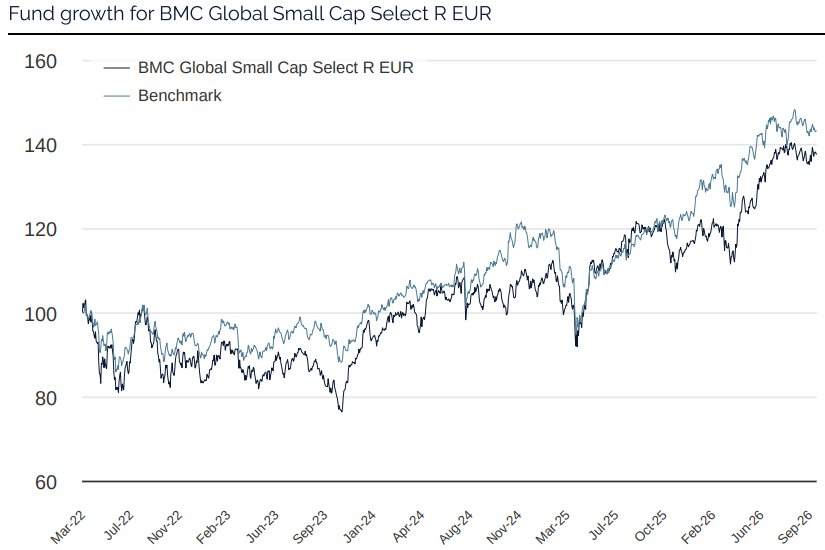
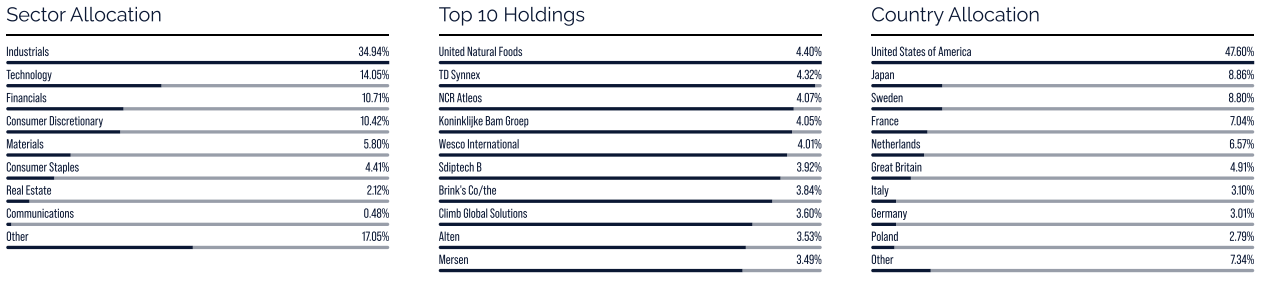
* The performance-based fee is 10% of the part of the total return that exceeds a so-called return threshold defined as the MSCI ACWI Small Cap Index (NTR), and is calculated according to the "high watermark" principle.

United Natural Foods
TD Synnex

NCR Atelos

BAM Group

Wesco
Riskinformation
Past performance is not a guarantee of future returns. The value of shares in the fund may go up or down, and an investor may not get back the amount originally invested
Monthly Newsletter | 9 okt 2026

Monthly Newsletter | 8 okt 2026

Monthly Newsletter | 7 okt 2026