
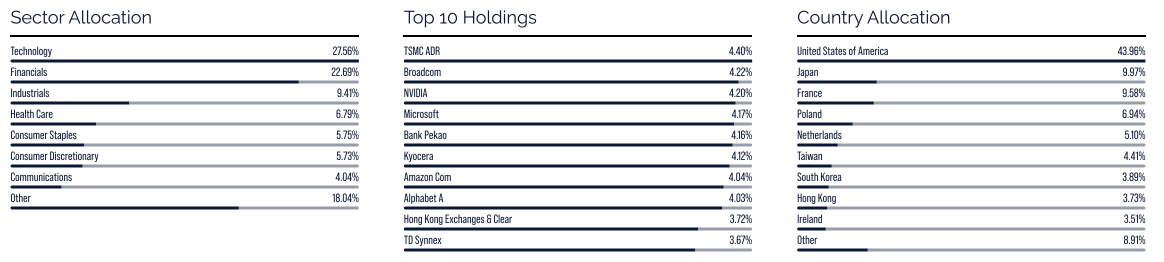
In our fund, AMD, TSMC, Bank Pekao, and PKO Bank were the best contributors to returns during September. And the weakest were flatexDEGIRO, HDFC Asset Management, Estée Lauder, and Hermes. We were especially pleased to see the two Polish banks in the #3 and #4 spots. During 2025, Poland saw GDP growth in USD of 3.6%, putting the country highest in Europe. As Poland's economy grows, earnings for banks also expand thanks to the increase in loans and deposits.
FlatexDEGIRO had a challenging month after the company appointed another CEO (it now has two) and made changes to its board. We believe, however, that despite these high-level changes, flatexDEGIRO is a fully functioning internet bank with exciting growth ambitions for equity trading and saving in Europe.
We were in California during September to meet software and semiconductor companies such as Nvidia, Broadcom, Cadence, Servicenow, and many others. Our conclusion from the trip is that semiconductor manufacturers are growing rapidly, while software firms still see challenges as the market has not yet decided whether AI disrupts their business models more than benefits them. You can read our blog post about our compelling California trip on our website.
From October 1, we are expanding the maximum number of holdings in BMC Global Select to 40 companies. This is to maximize our opportunities to generate returns for unitholders. Over the past 12 years, we have kept to a maximum of 35 holdings, but after analysis have decided this is too narrow. We note that we are not making any other changes to the fund's investment policy.
Key market events and trends
Year-to-date, the MSCI World index is up 17% in EUR. Returns have been driven by particularly robust profit growth, for which consensus estimates now point to more than 25% for 2026, while profit growth estimates for 2027 have been raised to 17% (from 14%). Excluding the rising interest rates, particularly in the US, share prices would have risen by more than 20% so far.
Bond yields around the world are up, and real interest rates in the US touched levels not seen since the early 2000s. Part of this rise can be explained by energy-driven inflation, but credit demand has also increased as governments continue to run unsustainable deficits, while capex investments in AI data centers push credit demand up further. As credit demand has now surpassed what the system can meet, real interest rates rise. Simply put, there is more demand for capital than supply, propelling the cost of capital upwards.
With share prices up 17% during 2026 and profits likely to surpass 25%, there is an implicit valuation contraction justified by the higher interest rates. Firstly, investors will be tempted to sell shares to generate a predictable income stream from bonds in the coming ten, 20, or 30 years. Secondly, the present value of shares will decrease as the discount rate rises.
Currently, the earnings growth rate appears able to offset the impact of higher interest rates. But as interest rates increase further, such as to 6.0% for the US 10-year yield, the equity markets will encounter problems. On the other hand, shares should perform well if inflation weakens during 2027, as is widely expected, with less headwind from the higher interest rates.
Q3 2026 reporting season is around the corner, and profits for S&P 500 companies are expected to be up 30%, spurred by remarkable growth of 65% by the tech sector. In Europe, the Stoxx 600 is heading for profit growth of 17%, thanks to the energy sector.
Portfolio changes
We made four changes to our global fund during September. The first two were regarding Special Situations. We sold freight company TFI International and instead bought US payments company Corpay. Corpay handles payments for medium-sized US companies, competing with medium-sized banks in the US. It has an especially stable business model and guides for 10% organic revenue growth and a solid 20% growth in earnings per share.
The other two changes were one Champion and one Special Situation. We sold building materials company Vulcan Materials, which is having a tough time in the US as the 30-year financing rate for housing construction there is now more than 7%. Owing to this, far too few homes are being built, which is directly negative for Vulcan. We see better growth opportunities in our new holding in Cadence, which provides software and sells IP for semiconductor design. Cadence is categorized as a Special Situation.
The fund's positioning
The fund's returns are created through a number of clear investment themes. Japan is one of the most compelling, with corporate governance reforms there forcing companies to focus on improving profitability and liquidation of cross-holdings—changes that are now reflected in rising share prices.
Poland is one of Europe's most attractive markets, where solid GDP growth is combined with expanding consumer saving. Our Polish banks benefit from both of these factors, with increased economic activity and a change in savings behavior also driving lending as commission income.
AI and data centers are another key theme. The establishment of AI infrastructure is a global phenomenon that has positive effects for a wide range of industries, from semiconductors to construction to energy supply and the electric grid. Our fund is exposed to this trend through companies both with direct and indirect links to AI investments.
We also see securities trading and saving in growth markets as structurally appealing themes. The exchanges we invest in generate stable revenues from transaction volumes and also benefit during periods of high volatility when increased market unease has historically spurred trading activity and thus revenues.
* MSCI AC World NTR USD in EUR

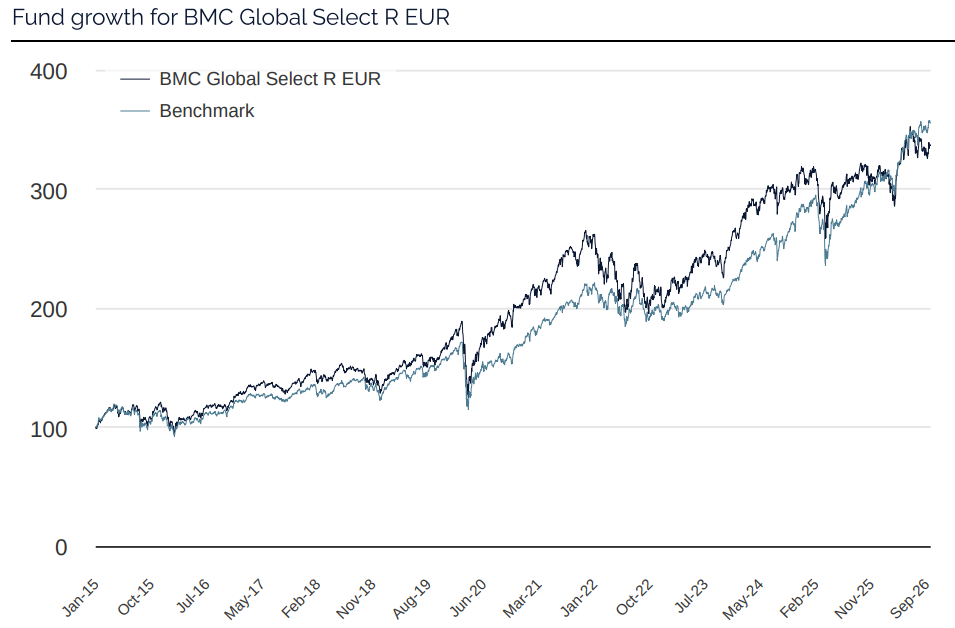
* The performance-based fee is 10% of the part of the total return that exceeds a so-called return threshold defined as the MSCI All Country World Daily Index (NTR), and is calculated according to the "high watermark" principle.
TSMC

Broadcom
NVIDIA CORP
MICROSOFT CORP
Bank Pekao
Riskinformation
Past performance is not a guarantee of future returns. The value of shares in the fund may go up or down, and an investor may not get back the amount originally invested
Monthly Newsletter | 9 okt 2026

Monthly Newsletter | 8 okt 2026

Monthly Newsletter | 7 okt 2026