
The figures in the reports spoke for themselves. At the end of July, we could conclude that almost all the companies in our global fund had reported impressive growth in both revenue and profit.
From time to time, the equity markets can be capricious, though, ignoring companies' favorable growth. We firmly believe that good growth figures win out in the end, being reflected in share prices. July was an excellent example of a time when the market chose to focus on the negatives instead of looking at the figures; Samsung's revenue has grown 130% y/y and its profit has flourished 1,814% y/y, but its share price was down in July.
For BMC Global Select, our holdings in Microsoft, Amazon, Mastercard, and Hong Kong Exchanges were the best contributors to returns in July. The worst contributors were SK Hynix, TSMC, Everus, and Kandenko. The outcome between the best and worst contributors for July was practically a mirror image of the previous month. In June, the semiconductor companies performed well and software was weak, while July showed the reverse. The market was delighted with the quarterly reports from Microsoft and Amazon, which both beat expectations. The Microsoft share was up more than 15% in one day, driven by growth in cloud services and rising sales of AI functionality. Amazon's share price also shot up on news of the report, rising around 15% the day after the figures came out. The primary reason for this rise in Amazon's share price was that growth in the company's cloud services, AWS, surpassed market expectations. We consider this impressive growth from Amazon given that AWS is the world's largest supplier of cloud services (public cloud). The semiconductor sector, including names like SK Hynix, TSMC, and Samsung, suffered in July as the market questioned the generally high level of investment into AI as a whole. Despite this concern regarding future revenues, all the semiconductor companies in our fund delivered particularly robust growth in revenue and profit.
Key market events and trends
At first glance, July appeared to be a calm month, with the global equity market (MSCI World in EUR) dropping back by 0.6%. But this hides one of the year's most powerful sector rotations. Semiconductors fell by 20%, the South Korean equity market lost 30%, and Tesla was markedly down, while the US telecom sector rose by 15%, energy climbed up 8%, the finance sector saw a 7% rise, and everyday pharma was up 5%.
This correction centered on AI-related topics. The greatest drop was seen in the AI and semiconductor spaces, plus the South Korean market, with its extensive exposure to memory chips. These have all been extremely popular, with increases of around 70% during the first half of the year. On top of this, we saw profit-taking, a more austere Fed under new chair Kevin Warsh, and a wave of liquidation of leveraged positions, including the Situational Awareness Fund being compelled to sell assets to meet the margin call. The underlying demand held firm, however, and reports from semiconductor companies and hyperscalers showed continued solid growth with rising revenue and profits. Overall, this appears to have been a healthy valuation correction of a structurally intact trend, rather than a sign of weakening fundamentals.
Estimates have been revised up—and our forecasts likewise. At the start of the year, we had forecast a total return of 10–15% for 2026. We raised this to around 15% after the convincing first quarter reports. And now—despite July's rotation—we see scope to lift it again, this time to 15–20%, given the second quarter results and updated valuations in play. This year's returns will be driven entirely by profit growth. The latest increases in long-term bond yields could pose a risk to keep an eye on, however, as if US 10-year yields surpass 5%, it could put pressure on share prices in general.
What do we anticipate for the fall? We expect the second half of the year to remain variable, the tone set by sector rotation rather than a broad-based general pickup. The underweight sectors—groceries, healthcare, telecom, and finance—seem to hold the best opportunities to continue making up lost ground, especially as many active investors are still underweight in these spaces. We would consider possible ongoing weakness in semiconductors as a buying opportunity, given the solid profit development expected there in 2026 and 2027.
Portfolio changes
During July, we bought French bank BNP Paribas. We consider this a golden opportunity to buy in when the stock trades at an especially appealing discount to peers. We expect future returns will stem from both profit growth and a revaluation of the bank.
In the healthcare space, we sold the long-serving HCA, which has been a holding in our global fund since February 2020. Over these six years or so, this US hospital company has delivered a return of 210% in Swedish crowns, making it a key contributor to returns during that time. Our new hospital company, Tenet Health, is also a Champion and provides similar services but with a higher growth profile. During July, we also bought another Champion, ASML, which partly replaces our sold Taiwan Union Technology holding. ASML is a quality company that more or less drives the developments in the semiconductor sector with its DUV and EUV machines. We look forward to SpaceX's pending order of new EUV machines for its terafab. Another bellwether Champion we sold during the month was Martin Marietta, as the company made a new acquisition (New Frontier Materials) that we don't think has turned out well. During our long holding period of almost a decade, Martin Marietta has delivered a return of more than 220% in Swedish crowns to unitholders.
The fund's positioning
We see a handful of decisive factors driving future returns in our global fund. Our Special Situations basket is now at 30%, packed with many exciting stocks that can deliver returns of 25–100%, depending on the length of holding. We also have a compelling exposure of around 35% of the fund to data center expansion, a highly invested area that benefits our holdings. Another driver is income from savings and the equity markets. Trade in China and Singapore and the growth in savings in Germany and Poland should create sound revenue for the fund's holdings in these regions.
*MSCI AC World NTR $ in EUR

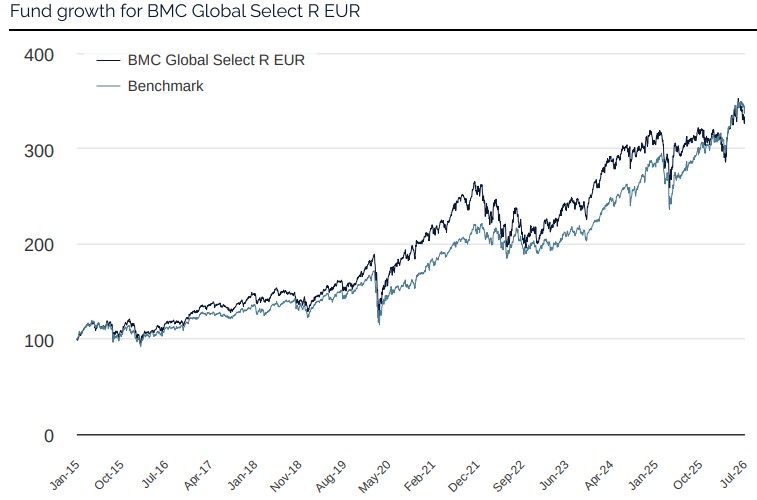
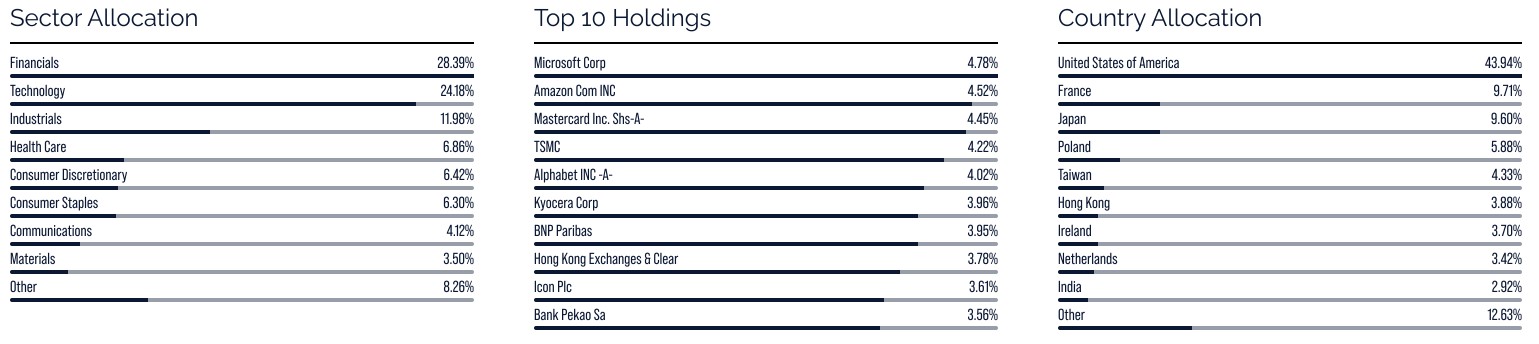
* The performance-based fee is 10% of the part of the total return that exceeds a so-called return threshold defined as the MSCI All Country World Daily Index (NTR), and is calculated according to the "high watermark" principle.
MICROSOFT CORP

Amazon
MASTERCARD INC
TSMC
ALPHABET
Riskinformation
Past performance is not a guarantee of future returns. The value of shares in the fund may go up or down, and an investor may not get back the amount originally invested
Monthly Newsletter | 11 aug 2026

Monthly Newsletter | 11 aug 2026

Monthly Newsletter | 11 aug 2026