Herman Ohlsson
Asisstant Portfolio Manager with a focus on the semiconductor industry, Brock Milton Capital AB

Our conclusion following the trip is that it remains a hot area, with many reasons why AI should continue to drive the market in 2026. Optimism continues, as do investments, which are increasing. The fact remains, however, that a handful of US tech giants still account for a vast majority of AI investments, bringing some fragility, especially given that these are increasingly being financed with debt rather than capital. We see reason to be more selective as the risk profile has changed, but we maintain our very positive stance on tech companies in general.
AI optimism remains high, but so too does awareness of risks
It was clear during the conference that the greatest challenge for companies is how they will meet the substantial demand that exists. Several companies emphasized the high visibility in the coming years as a result of this robust demand. The curve continues upward in terms of use of AI applications and models, even to the extent that ChatGPT, for example, has chosen to limit free usage. Microsoft also stated that capacity, rather than demand, is key right now.
It is also not unusual that in some meetings the companies talked about high visibility through 2027 and even into 2028. One of these was Celestica, which assembles servers for Google, among others. Its TPU chip is driving strong demand, which we consider a good sign for our holding Broadcom, which designs Google's TPUs. Nvidia was not to be outdone, announcing at its presentation that none of its latest OpenAI partnerships were included in its previously announced backlog of USD 500bn for its Blackwell and Rubin chips. This proved a further powerful signal of the ongoing strength of demand for the latest chips.
Despite one positive signal after another at the meetings, there was caution regarding 2026 following the stellar stock market year of 2025. Many questions were raised about the risks and challenges ahead, for example. My impression is that several companies are well aware of these, as were attendees. Major topics of discussion were how tight the supply chain is, potential future overcapacity, the risks involved in debt financing AI, and that not only is electricity in shortage in the US but also the labor force—which in some cases is considered more acute than electricity.
Capacity is scarce in some parts of the semiconductor value chain
The solid demand driving the entire AI market recently has now started to have consequences for the AI supply chain. This applies not least to electricity, which is an acknowledged bottleneck in US infrastructure planning of data centers, and also to the labor force. Simply put, there aren't enough electricians to build and install all the data centers, largely as a result of strict immigration policies. The electricity issue has been temporarily resolved by building data centers "off grid"—not connected to the local electricity network—and instead installing standalone turbines that generate their electricity, often with natural gas as the main energy source. This will only accelerate the US's investments in electricity production and the power grid in the coming years.
This challenge has also led to companies such as Amazon, Microsoft, and Google as recently as December announcing massive investments in India for the coming years. That country has a massive energy surplus and thus cheap electricity, the key component for AI.
Beyond electricity and labor, the supply chain for memory chips has also proven tight, propelling prices upward. Companies like Micron, a holding in BMC Global Select, do not have the capacity to meet the demand for AI chips and have not allocated any to end-products such as smartphones or computers either, pushing up prices for memory by a massive 171% during Q3. All memory manufacturers are also sold out for 2026, while the importance of memory for AI only grows. More investments are required to expand the production capacity, and several factories are being expedited as far as possible. Most of these won't be ready until 2027 or 2028, implying ongoing price increases that provide operational leverage for memory companies in the coming quarters.
Rising demand for memory chips also depends on the increased need for hard disks (HHDs) that comes as a consequence of AI, especially in video generation. Seagate, which manufactures HHDs for data centers, describes AI as "the golden age for the company" as demand has outstripped supply for more than two years, while the gap between them is ever expanding. The company's products are sold out for 2026, and it is now only taking orders for delivery in 2027 at the earliest.
When meeting our holding TSMC, it was also patent that it too faces challenges in meeting demand, most of all for 3nm and 2nm chips (the most advanced). TSMC is, however, and has always been, particularly conservative in adding capacity. The company highlighted that it dislikes adding capacity given the subsequent risk of declining demand. According to the company, this cycle is unique in that its customers—Microsoft, Google, Amazon, Meta, etc—are now discussing directly with TSMC how to ensure capacity to meet demand. TSMC has ensured these customers have sufficient data centers and electricity to now invest in the required manufacturing capacity. This reiterated what we heard when the company released its stellar Q4 report the week before. The company raised its investment rate considerably, pointing to the exceptionally strong demand for AI chips in the coming years, with this increase in visibility much appreciated by the market.
Continued low interest in software firms creates opportunities
After a troublesome 2025, the software companies offered no clear signals. Many have performed poorly owing to the view that AI will hurt growth owing to the competition for customers' IT investments, with demand for the number of subscriptions likewise impacted as AI efficiency increases. However, there is a considerable difference between companies, with sentiment tending to shift rapidly. Google, for example, closed the year up 65% despite a decline of 25% earlier. This came after the market had considered the company out-competed by OpenAI, with search engines dying out. This forms a great example of when the market only sees in black and white and cannot handle two thoughts simultaneously. AI isn't a zero sum game. We don't ask ChatGPT the same things as we search for on Google. It is, however, interesting to note that the growth in Google searches today mainly comes from longer and more complex search terms than before. This is a sign that users have likely copied this ChatGPT habit to their searches. Google is one of the largest holdings in BMC Global Select and BMC Global Technology, and it was the largest positive contributor to the Global Select fund last year.
In general, we believe that a software company like Microsoft will remain well positioned in the long term thanks to its diversified business model, rapidly growing cloud services, and access to OpenAI's technology and models. Demand for its Azure cloud services could have grown even more quickly than the 39% of the latest quarter had the company had more capacity available (according to the meeting with the IR). We believe the companies to benefit will be those with sizable user bases, "mission-critical" products, and that are hard to disrupt with AI, like our BMC Global technology holdings Intuit and Autodesk. The companies also generate good cash flows at a reasonable valuation.
Quantum computing can challenge data centers in the long run
During the conference, I met several quantum computing companies that manufacture and operate such computers. We will be publishing a longer blog post on this topic shortly, but put briefly, our collective view is that this technology remains at an early stage, although massive steps have been taken recently. At the same time, revenues are virtually non-existent for many of these companies as further breakthroughs are needed ahead of a potential broader commercialization. It is also worth pointing out that quantum computers are not built on a common technology that all the companies develop, but different tech that is being developed in parallel. Opinion is divided as to which has the greatest potential to reach "quantum supremacy," which is when a quantum computer successfully cracks a calculation that is considered impossible for today's computers to solve.
When a quantum computer possibly manages this, there will be consequences for today's supercomputers (GPUs) that currently equip the world's data centers. This is because a calculation that would take millennia to solve with current technology could be cracked in less than five minutes by a quantum computer. The extent to which the technology would cannibalize current tech from Nvidia, for example, remains to be seen, however. It is unlikely that a quantum computer would operate cloud services or undertake simpler calculations, as that would be like killing a mosquito with a cannon or hitting a nail with a sledgehammer. But opinions are still divided on which is the most advantageous quantum tech with the greatest potential to come out on top. What the quantum companies were unequivocally in agreement on was that Google has the most advanced quantum computers among the US hyper-scalers.
Thoughts for 2026
After the week in Arizona and meetings with some of the world's largest tech companies, we can say that optimism is also high for 2026. Many spoke of further increases for tech companies, given the tightness of the supply chain and the ongoing strength of demand. China still holds upside for the industry, as it now appears that purchases of Nvidia's more advanced H200 chip will be allowed, which should add billions to the company's sales as early as 2026. Just as China represents an opportunity to spur on this already hot market, it can also slow it down with its rapid pace of innovation in AI models as more chips become available, just as we saw with DeepSeek almost exactly one year ago.
Possible negative signals to watch out for during the year could be any factors that affect future willingness to invest in AI. These include problems with debt financing or returns on investments or "scaling laws" for AI models declining, which in one way or another would affect the willingness to invest.
We believe the key is to be more selective and move away from the infrastructure layer of the value chain and more toward software or innovation-driven companies that develop new tech, plus companies that can benefit from the spread of AI usage across more industries. For BMC Global Technology, we choose to focus on companies with stable earnings, growing profits, and that already create robust cash flows. The portfolio today comprises 35 exciting companies across various industries that benefit from technology and have different drivers for their returns. 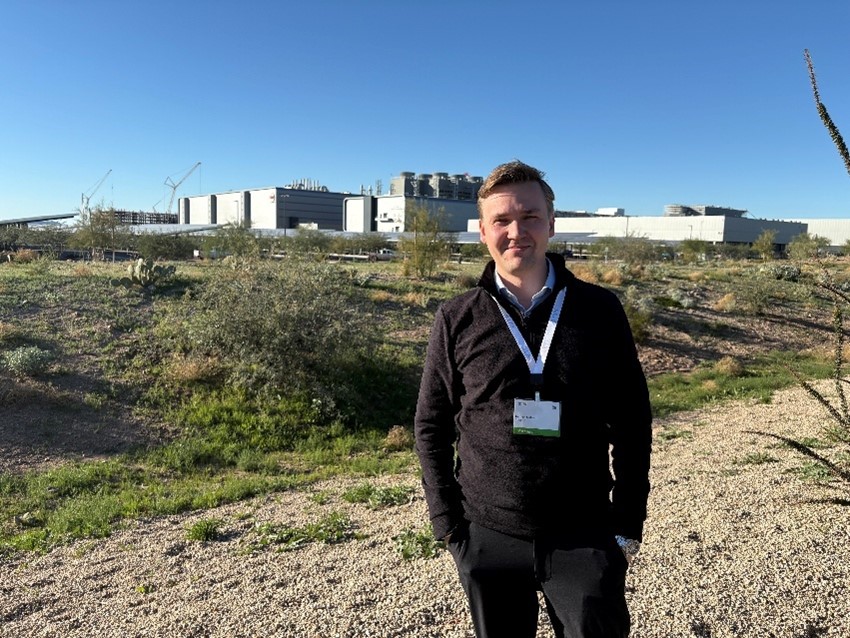
In front of TSMC's Fab 21 plant outside Phoenix, Arizona. This is where is TSMC is based in the US, with three factories at present, with plans to add three more in the coming years. Photo: Brock Milton Capital.

Asisstant Portfolio Manager with a focus on the semiconductor industry, Brock Milton Capital AB
Blog | 5 okt 2026
Blog | 1 okt 2026

Blog | 23 sep 2026