The strongest contributors to the fund's returns in October were Allegro, Spotify, and Scout24 while the weakest were Celestica, Alphabet, and Intel.
October was, to say the least, a turbulent month for the tech market. This stemmed from two factors. The first is declining growth for Anthropic, while the other was negative cash flows for the US hyperscalers. Other factors like the war against Iran, inflation, and higher interest rates also had an impact. None of these were news to the market, but they represent further simple arguments for selling tech stocks.
Anthropic's growth pace was a victim of expectations. The market had anticipated a growth rate in Q3 surpassing the 45% (q/q) stated in the updated prospectus. Growth in Q1 and Q2 came in at 131% and 144%, respectively. The 45% rate thus implies a slowdown in growth in percentage terms but still solid growth in absolute figures. The company continues to grow by around 10% a month, which should mean it reaches just over USD 100bn in ARR by year-end. The prospectus also revealed that the company was profitable in Q2 when adjusting for a debt instrument that increased in value (accounting adjustment that does not affect cash flow) and had positive cash flows with around USD 131bn in cash. Extremely rare figures for a growth company expanding at this pace.
What we see now is a rotation out of tech stocks. The market is repricing stocks to account for the negative cash flows among the US tech giants. This all started just over a fortnight ago before accelerating after last week's reports from Google and Amazon, in which both companies fell short of expectations in their core businesses and saw their negative cash flows becoming larger owing to their substantial AI investments. Hardly an optimal outcome, but we believe the markets have overreacted as nothing changed that much regarding their future earnings, despite them missing expectations for the quarter. Meanwhile, their cloud businesses grew y/y by 103% for Google and 39% for Amazon, with margins at 40–50%. These solid figures imply substantial demand for their cloud and AI services. Despite the market's negative reaction, both companies signaled that they will increase investments "significantly" next year. And with these growth figures, we understand why. Our positive view on tech stocks is thus unchanged, as demand for AI remains demonstrably higher than supply and the technology remains at an early stage.
During October, we attended Nvidia's GTC 2026 AI conference in Berlin, at which we joined a group meeting with the company's CEO Jensen Huang. We will soon publish a blog post about the conference on our website. During November, members of our investment team will travel to China to take part in a massive tech conference in Shanghai and to meet companies on their home turf, following this with a trip to South Korea to meet, among others, SK Hynix—one of the world's largest memory chip manufacturers and a holding in the global fund. Apple recently released its latest quarterly report, highlighting elevated memory chip prices as a cost factor, which should benefit both Samsung and SK Hynix.
Key market events and trends
MSCI World (EUR) was up 0.1% in October, with a 1.6% strengthening of the dollar offsetting the decline in MSCI World measured in USD. Year-to-date, MSCI World (EUR) is up 17.0%. Behind this seemingly unchanged front, defensive sectors like food and healthcare led the way, while semiconductors dropped back somewhat. October was affected by market uncertainty, with increasing interest rates dampened to a certain extent when the US 10-year yield moved downward.
The seasonally weakest part of the year is now in the rear-view mirror and was surprisingly calm in 2026 when viewed on the index level. This was despite geopolitical worries, social unrest in parts of Europe, an unclear US policy direction ahead of the mid-terms in November, and a steady stream of experts raising concerns about the AI sector.
Over the past decade, passive equity funds have grown to more than USD 22 trillion. Passive capital buys the index regardless of fundamentals, risk, or valuation. The consequence is that volatility in individual stocks in MSCI World is at its highest in years. We expect this to continue, so prepare for larger movements than investors are used to in individual shares. The massive drop in US tech stock prices during October is clear evidence of this.
Consensus estimates for Q3 2026 profits were revised up by 1–3 percentage points in recent months. Profits in S&P 500 are expected to grow by 31%, driven by exceptional growth of 67% in tech stocks. In Europe, Stoxx 600 is expected to reach profit growth of 22%.
Portfolio changes
During October, we added a new holding: Japan's TDK, which is, among other things, the world leader in smartphone batteries and manufactures passive components for data centers. We also sold four holdings in October: Schneider Electric, Revo Insurance, Netflix, and Adyen.
The fund's positioning
The fund now comprises 42 companies exposed to a range of sectors, geographies and drivers, with companies chosen on their own merits. We do not limit ourselves to IT companies but also invest in those across various sectors benefiting from technology. We believe a concentrated but also diversified, actively managed global technology fund focused on stockpicking has all the prerequisites to deliver great returns to its unitholders over time.
*MSCI AC World NTR $ in EUR
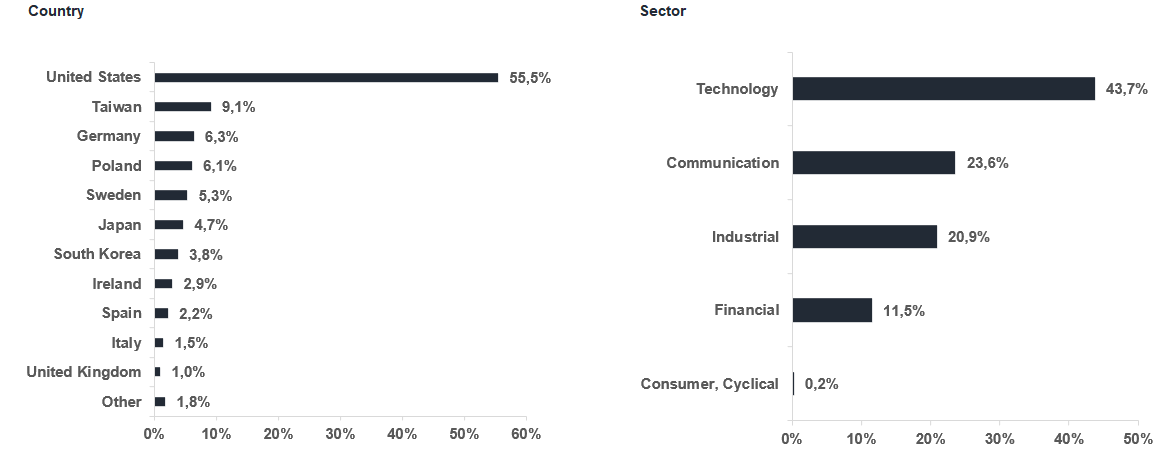
* The performance-based fee is 10% of the part of the total return that exceeds a so-called return threshold defined as the MSCI All Country World Daily Index (NTR), and is calculated according to the "high watermark" principle.

MICROSOFT CORP

Allegro

Amazon

Broadcom
TSMC
Riskinformation
Past performance is not a guarantee of future returns. The value of shares in the fund may go up or down, and an investor may not get back the amount originally invested
Monthly Newsletter | 9 nov 2026

Monthly Newsletter | 9 nov 2026

Monthly Newsletter | 8 nov 2026