Herman Ohlsson
Asisstant Portfolio Manager with a focus on the semiconductor industry, Brock Milton Capital AB

Most striking was how consistently the companies described the situation: construction is not happening quickly enough to meet demand, regardless of whether we met chip companies, equipment manufacturers, or cloud suppliers. Many companies have upped their expectations during the fall. Nvidia guides for almost 70% growth next year, up from its previous expectation of 45%. Broadcom's CEO signaled even stronger demand, with guidance for growth in the company's AI chip business of 100% for 2027 and 2028. CoreWeave, which rents out data center capacity, described demand as far above supply; it has thus raised prices for all GPUs by 25%. Equipment manufacturers such as Applied Materials, which previously stated visibility for demand a couple of quarters ahead, now sees record-high visibility for the next two years. The company plans to double its manufacturing capacity by 2028 to meet this demand.
At the same time, the bottleneck has moved. Two years ago, a shortage of AI chips was the key issue. Today, the problem is memory, silicon wafers, optical components, and, most of all, electricity. Several companies mentioned that access to electricity is the greatest restriction in the long term. A recurring point was also that a majority of the world has still barely started using AI. The message was clear: we are still at an early stage in the cycle.
Anthropic and OpenAI the next generation of cloud giants
Perhaps the most important structural factor for leading AI companies like OpenAI and Anthropic is that they have so far leased computing power from Microsoft, Google, Amazon. Now they are beginning to build their own data centers, starting from 2027 and accelerating in 2028. They are all increasing their use of own custom-designed chips, ASICs. Anthropic has recently hired Google's former head of chip development, and OpenAI is set to launch a new chip developed by Broadcom at the end of the year.
The logic for the companies is plain and follows the same trend as the hyperscalers. Once sufficient scale is reached, it becomes cheaper to tailor hardware to own models rather than buy generic graphics processors from Nvidia, for example. According to Broadcom, the amount of special chips will already be greater than the number of graphics processors in 2028 as both Anthropic and OpenAI scale their production. This was also confirmed in our meeting with Cadence (one of our holdings), with these AI companies having become its fastest-growing customers, with room to expand even further in the coming years.
This changes the industry power balance. Nvidia is addressing these developments by focusing on open AI models, on companies that want to run AI in its own data centers, and on smaller cloud suppliers. For us, this means that the winners of the next phase will not necessarily be the same as those in the current phase. So far, the supply of chips is severely limited, affecting all the companies in the value chain. The expected trend is clear, though: future winners will be the companies that develop their own AI chips or sell CPUs. The largest holdings in BMC Global Technology around this theme are AMD, Mediatek, Broadcom, Cadence, and Intel.
Optical—the next big AI growth area
Today's AI chips are so fast that the real limitation is often how rapidly data can be transferred between them. Ongoing development at this pace risks that chips prove limited with communication using copper cables. The switch to optical is thus essential. Optical communication offers greater bandwidth over longer distances using less current.
This change is expected over several stages:
Each stage can multiply demand for optical solutions. The market for these optical components is expected to grow from around USD 18bn today to more than USD 90bn by 2030. Some analysts expect USD 150bn as early as 2028. Although this is a highly complex technology, the market holds enormous potential as such scope for application is expanded into data centers. We have several companies in BMC Global Technology that manufacture fiber-optic cables but are also evaluating other areas of this value chain. Optical is a superb example of how to earn money on a "trend within a trend."
Circular financing a temporary solution
Both Nvidia and Broadcom have recently been diligent supporters of their own customers to ensure they continue building their data centers. This has been in the form of investments, collateral, and guarantees, to help customers either get hold of the capital needed or to reduce their financing costs. The need has been considerable, as the initial capital requirement to build a data center and purchase chips is sizable before any earnings can be accrued once operational.
Nvidia has been the most active on this front, but its investments in customers are around a few billion dollars, while its revenues hit just over USD 400bn. The company also emphasized that these guarantees issued to OpenAI, among others, will disappear once they have scaled up their operations and reached an Investment Grade rating. It is thus not a matter of providing capital to these companies but also supporting them towards a goal of better creditworthiness. This means its support is only temporary in nature. On the same theme, Broadcom pointed out that it does not expect to have pledged collateral or guarantees after 2028, when Anthropic and OpenAI have scaled up their businesses.
Quantum computers—hope for wider commercialization in the coming years
During our analyst trip, we also took an exciting meeting with Rigetti, which develops and manufactures quantum computers. We got the opportunity to see how the technology works and how it is expected to scale in the coming years and learned about the biggest challenges today. Its quantum computers today have 100 quantum bits (qubits) and are expected to reach broader commercialization within two to three years once they achieve several thousand qubits. The largest application areas will primarily be within logistics optimization, research, and drug development, and they are unlikely to cannibalize traditional data centers.
Rigetti's computers operate at a temperature close to absolute zero (-273 degrees), the coldest temperature in the universe. An entire quantum computer utilizes less than 50kW of electricity, compared with the 200kW expended by Nvidia's latest server rack. It makes its own chips with 20-year-old machines. The greatest challenge is not manufacturing the chips but getting the qubits on these to communicate with each other. This complex but thrilling technology is one we will be keeping a close eye on.
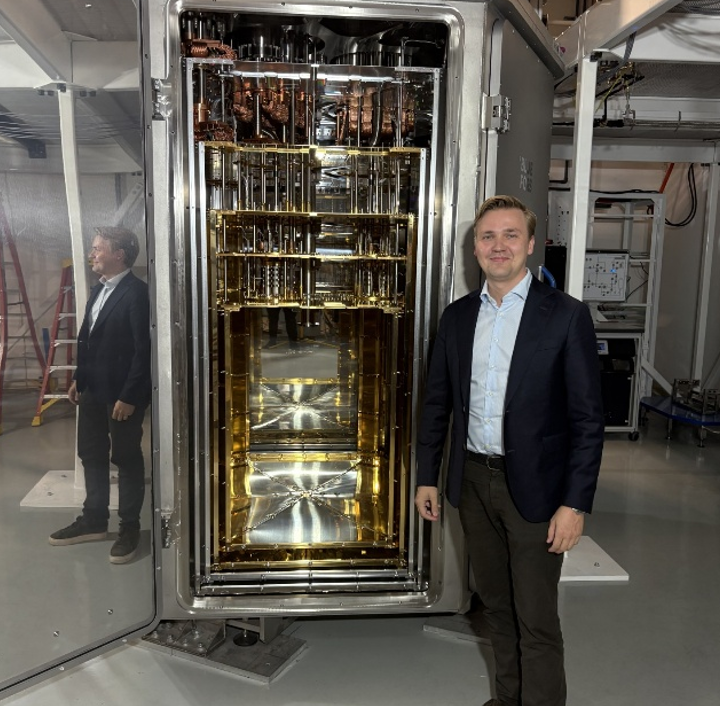 Assistant investment manager Herman Ohlsson beside Rigetti's latest quantum computer
Conclusion
After spending a week in Silicon Valley, our impression is that tech stocks still appear likely to perform strongly in the coming year, given their key financial figures. Demand still outstrips supply by a wide margin, while the order book is full and offers superb visibility. The greatest headache for the market right now is access to electricity, which remains the greatest challenge. Companies have visibility in the near term, but comprehensive planning is required to solve the energy need in the longer term. At the same time, we cannot help but be impressed by the capacity for innovation across the entire value chain. Right now, we find ourselves four years into the cycle started when Chat-GPT launched and the ability to resolve supply chain bottlenecks is striking.
As investment managers, our focus is on identifying the new trends that can resolve these challenges in various ways. We believe there remains considerable upside in the market today. We also have a feeling that the market underestimates how large ASICs will be in the coming years. As usual, we returned home with new knowledge, a greater understanding, and many new investment ideas that can generate returns for our unitholders.

Asisstant Portfolio Manager with a focus on the semiconductor industry, Brock Milton Capital AB
Blog | 5 okt 2026
Blog | 1 okt 2026
Blog | 23 sep 2026