
The strongest contributors to the fund's performance in June were TSMC, Intel, and AMD, while the weakest were Oracle, Microsoft, and Broadcom.
June was another month with positive increases in tech, but with the performance leveling off following the strong growth seen since the market reached its trough in March. The market remains extremely volatile, and news and data points continue to steer AI sentiment on a daily basis. We believe the most significant indicators will be the new revenue figures from Anthropic, a company that is likely to go public during H2 and which we assume will be valued at around USD 2–3bn.
During the month, we saw a robust performance by the fund's semiconductor companies, especially competitors to Nvidia and its value chain. This is one of the trends we've seen in recent months: customers searching for alternatives to Nvidia, leading to these companies' share prices increasing sharply. Since the start of the year, we have positioned the fund for this, which has generated good returns for unitholders. We expect this trend to continue, creating several winners when the market broadens out in the sector. Intel rose on the news of production for Apple, TSMC continues to expand its capacity as rapidly as physically possible, and estimates for AMD have risen further as the market needs more CPUs for inferencing—the next big phase within AI.
The first half of 2026 saw an especially strong equity market, despite geopolitical issues, not least the conflict in the Middle East, shifting inflationary and interest rate expectations, and rapid sector rotation, all prompting significant price fluctuations. AI continued as the key equity market driver, while energy stocks caused the S&P500, for example, to generate negative returns during the first half of the year. Companies within AI infrastructure, semiconductors, and hardware have remained the driving force behind this development. The equity market's focus and the concentration of performance around the AI theme increases the risk, however. Today, AI-related companies account for nearly half of the S&P500's market cap. In such a market, diversification is especially important, and this has been our strategy for the fund since day one. A broader tech fund investing in tech winners across several different sectors also offers a diversification of driving factors behind returns. The fund's returns during the first half of the year have been broadly diversified for a tech fund, with few companies contributing negatively to performance.
We expect the strong development in AI and tech will persist in the second half of the year, even if corrections and profit-taking are seen at regular intervals. Profit estimates for the fund's companies are up substantially and total data points suggest that strains in the supplier chain will persist as AI use broadens. AI will continue to characterize the market, but we believe the focus will shift to the various levels within the technology.
Key market events and trends
The first half of 2026 ended with MSCI ACWI up 14% in euros. This return was largely created during the second quarter, when the index rose by 16%, making this one of the strongest quarters of the past 25 years. The first quarter was weakened by geopolitical unrest in the Middle East and sharply rising energy prices, with the stock market lifting once these tensions eased.
The half year can be characterized as a market in constant rotation: gold and silver were in the lead initially, followed by oil and gas in March, as the war with Iran dominated. From April, AI infrastructure, memory chips, and semiconductors were at the forefront, while SpaceX's record IPO in June spurred positive sentiment further. The semiconductor sector rose by 88% in the second quarter, thanks to solid profit growth in Micron, Samsung Electronics, and SK Hynix.
AI remains the dominant driver in the market. Data centers are being built at an extraordinary pace across the globe, and AI-driven products are increasingly woven into everyday life, a definitive sign that this is a structural trend sooner than a transitory theme.
It is worth noting that the solid boost to the market in the second quarter was created by only a handful of companies. The market breadth (the number of companies in the index driving the returns) is typically at 35–60%. During Q2 2026, it was at an unusually low figure of some 25%.
It is positive that the fundamentals of global companies as a group continue to strengthen. At the start of 2026, the market forecast profit growth of around 14% on average for the MSCI World index. This has since been revised upward to 22%, with expected profit growth of a further 14% for 2027.
Portfolio changes
During June, we bought two companies: Allegro and SpaceX. We also sold off Meta and Euronext. Our exit from Meta was prompted by our belief that the company has fallen behind with its AI initiatives. And we sold Euronext to make room for ideas offering greater upside.
Allegro is Poland's leading company in e-commerce and the country's equivalent to Amazon. Its share has long traded at a sizable discount to its historical average, despite the company's ongoing solid underlying performance. It trades at a P/E of 14x, and we anticipate excellent opportunities for further growth and margin expansion.
SpaceX undertook a record IPO of close to USD 1.8bn, and we bought in on listing day. The company is unique in many aspects and sees incredibly strong momentum with AI and Starlink. It has contributed positively to returns in June after we added it as a Special Situations holding.
The fund's positioning
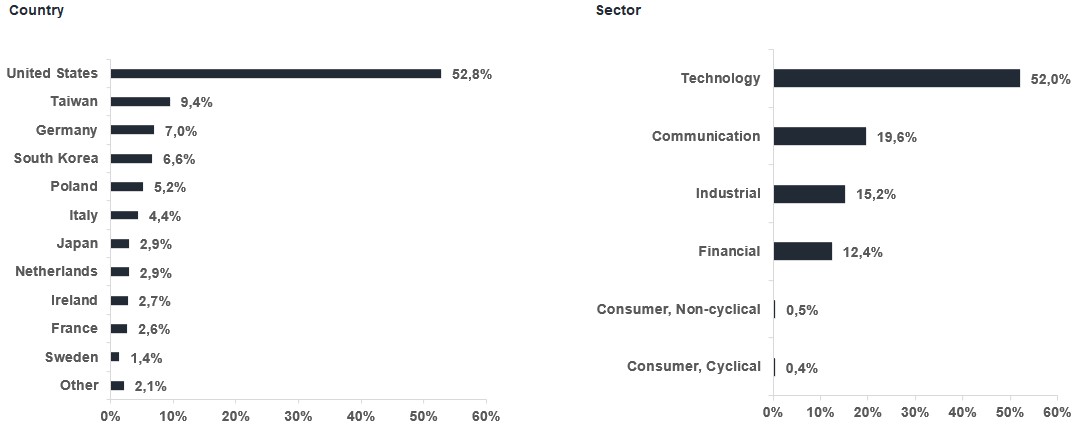
The fund currently comprises 42 companies exposed to a range of sectors and geographies, with companies chosen on their own merits. We do not limit ourselves to IT companies but also invest in those across various sectors benefiting from technology. We believe a concentrated but also diversified, actively managed global technology fund focused on stockpicking has all the prerequisites to deliver great returns to its unitholders over time.
* MSCI AC World NTR $ in EUR
* The performance-based fee is 10% of the part of the total return that exceeds a so-called return threshold defined as the MSCI All Country World Daily Index (NTR), and is calculated according to the "high watermark" principle.
TSMC
ALPHABET

Amazon
MICROSOFT CORP

AMD
Riskinformation
Past performance is not a guarantee of future returns. The value of shares in the fund may go up or down, and an investor may not get back the amount originally invested
Monthly Newsletter | 9 sep 2026

Monthly Newsletter | 9 sep 2026

Monthly Newsletter | 9 sep 2026